
You might not think much about zoning and land use but these policies shape our city. Right now, we all have an opportunity to get involved!
The city is seeking public feedback on a revised zoning ordinance for all of Harrisonburg. Luckily, they have spent a lot of time putting information in easy-to-understand terms and created a few cool tools to explore the proposed zoning changes.
There is one more public engagement session on Monday, Oct. 26. If you can’t make it, you can review materials online and take a survey with your feedback or email CDPlanning@HarrisonburgVA.gov. Everything you need to know about the project is here: https://www.harrisonburgva.gov/zoning-ordinance-update
For downtown fans, HDR wanted to share some of our recommendations and point you toward things you might want to look at. We encourage you to also give some thought to your own neighborhood, too.
When the zoning update is finalized, it will go to city council for adoption. Our new zoning ordinance will not require all properties to make changes to be in compliance. It will apply to future projects. For example, the new zoning proposes prohibiting drive throughs downtown (like a restaurant or bank), but if a business already has one, it won’t be forced to remove it. There just won’t be new ones in the future.
Check out these resources
1. Start with the cheat sheet on the project. https://www.harrisonburgva.gov/zoning-ordinance-update#docaccess-90464bdd5d5bf2f822e1a9292c750285 This resource is a great overview. Note that big changes and controversial issues are not being tackled in this update. If there are things you would like to see addressed in the future, the city is collection those ideas.
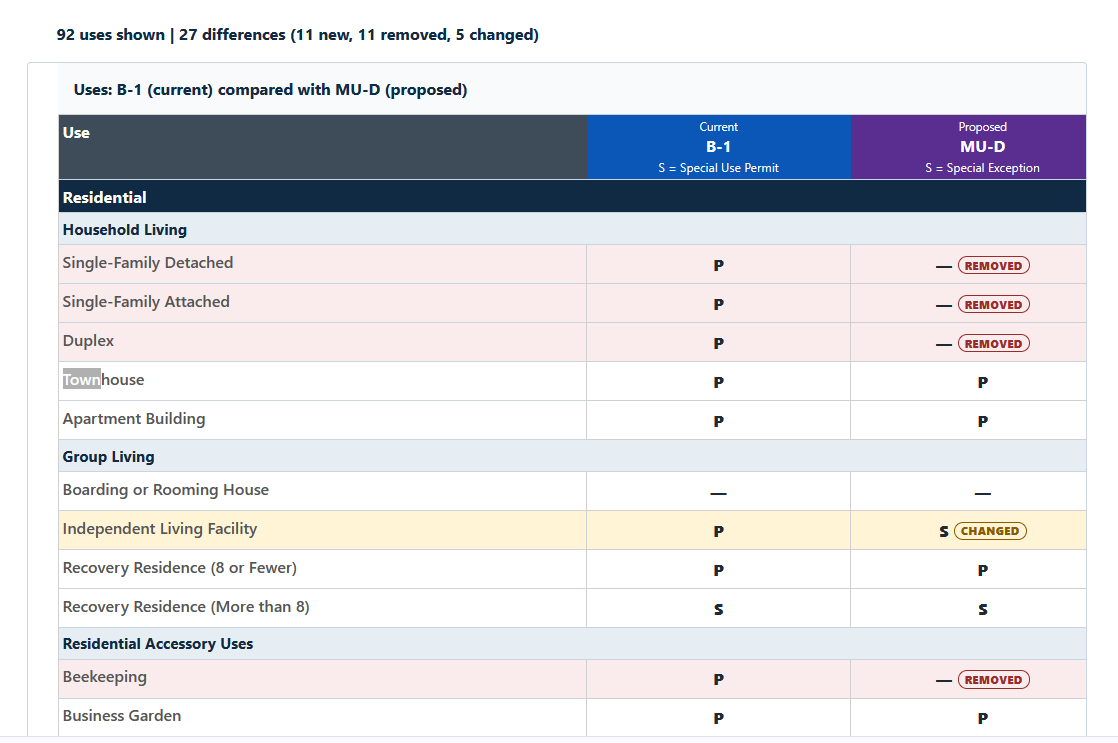
2. Check out the current & proposed zoning comparison tool. This tool is super cool because you can select a current zoning category (downtown is currently in the “B-1” zone) and compare it with the proposed zoning (downtown’s zone will be named “MU-D” for “Mixed-Use District”). It populates a chart that shows you what is allowed and not allowed currently and if a change is proposed. “P” means something is allowed and “S” means it could be allowed if approved via a special use permit or special exception process.
a. This is a really important chart to read. Look for the types of businesses that you think fit in with downtown and if they should be allowed outright or if they should go through a process for approval.
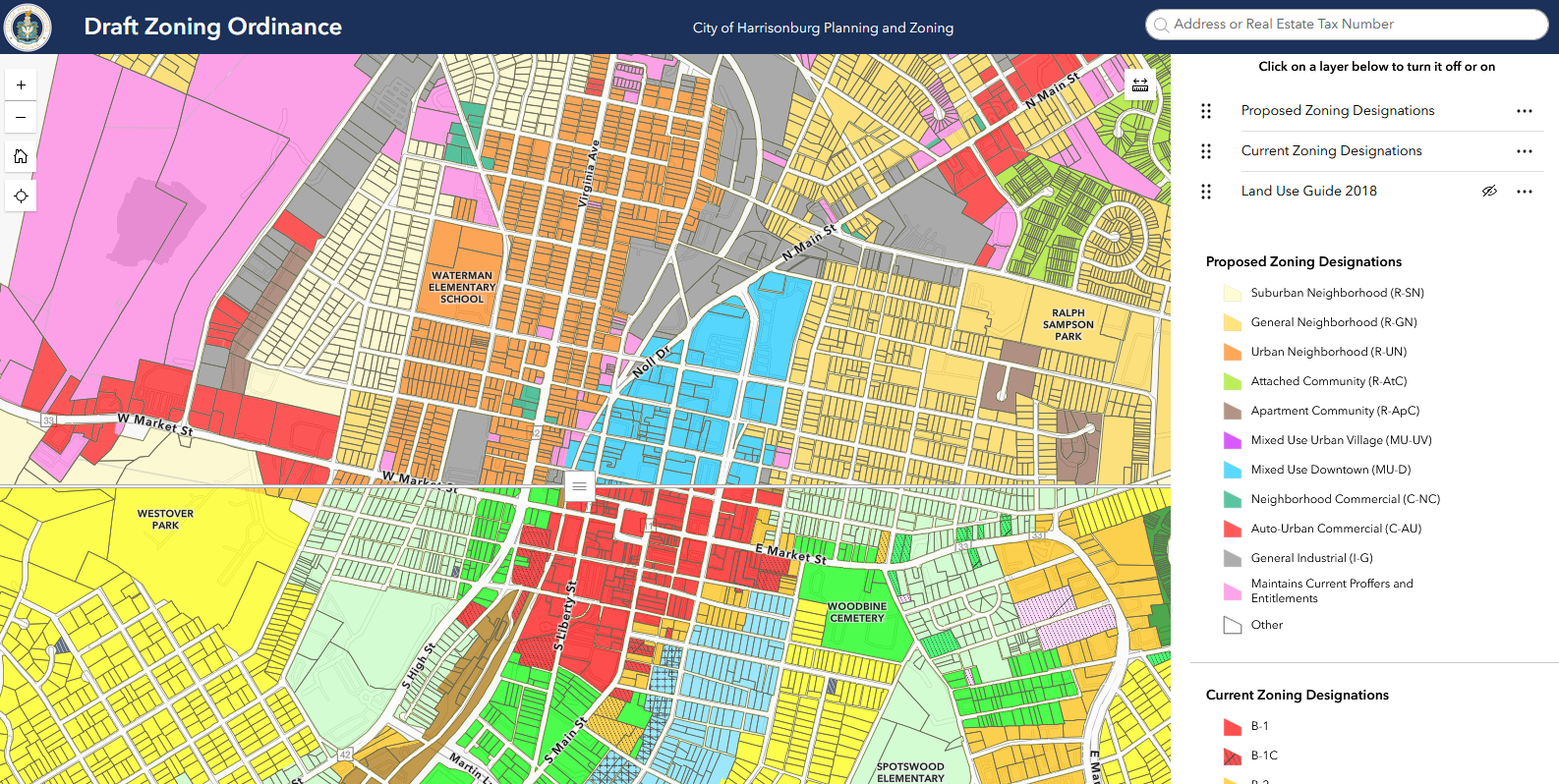
3. Play with the proposed zoning map. This has a neat “swipe” tool that you can activate to slide up and down the map to see which parcels are being reclassified and if boundary lines are changing. For downtown, a few properties downtown that weren’t in B1 are moving into the new MU-D zoning category and vice versa.
What Do We Like about the Proposed Zoning for Downtown?
Sandwich board signs are allowed – businesses rely on these to capture customer attention.
It makes sense to include properties adjacent to the current B1 in the new MU-D
Single family homes and duplexes are prohibited in MU-D so we can focus on higher density housing
Vehicle sales, repair, and other related services are prohibited in MU-D. New businesses that are retail, restaurant, office, and other personal services in the commercial district help with pedestrian flow and customer sharing while also reducing car activity in driveways along the sidewalk.
Drive throughs are prohibited in MU-D, which is great to support the pedestrian-orientation of downtown.
What are Our Recommendations for MU-D?
Fueling stations should be prohibited.
Gas stations have multiple cut curbs, which is bad for walkability. Pretty much every route from all directions leading into downtown has a gas station. We don’t prefer auto-oriented businesses with curb cuts along the side walk downtown.
Allow the following business uses by right: retail showrooms, funeral homes, home improvement stores (with appropriate square footage), and pet grooming and veterinary clinics (for small animals without boarding)
Lauf Cycles is developing a showroom now and this fits in with downtown; the Lindsey Funeral Home worked well downtown for decades; Randy’s Do It Best had a downtown shop and it was a good fit (big box home improvement stores wouldn’t work as well); and a vet’s office or pet groomer is a great service business – we are a dog-friendly downtown!
Golf courses and public schools should not be allowed. Downtown’s property assessments are high and the district brings in considerable revenue. For economic development goals, taxable uses makes sense. We can’t see how a golf course, if it was even possible to put downtown, would make sense.
Include 252 N Mason Street in MU-D and not General Neighborhood.
This is the Green Book House, which has an organization working towards turning it into a museum. The property is in B1 now and should stay with the same zoning.
Allow townhomes by special exception instead of by right.
Townhomes will work well in certain areas, for example, on the edge of sections of downtown, but less so in the commercial heart. Our preference is to add mixed-use commercial and housing projects in downtown where and when appropriate and consider the location and context of the surroundings of future townhomes in the commercial district.
We ask that the city work together with HDR to develop design guidelines for existing buildings and a pattern book for new construction in the historic district in the future.
HDR encourages you to share your feedback after interacting with the online resources or the open house. We also encourage you to ask that the city to work in partnership with HDR on a local historic district.
When reviewing the maps and proposed zoning changes, whether it is for downtown or your neighborhood, think about the best uses for the land, consider the proposed lot lines, which boundaries make the most sense, and if specific things should be allowed or if they should only be allowed if they go through a formal approval process. If there are more complex things you would like the city to tackle in the future (e.g., historic district design guidelines), create a list to share, too!