
Remembering HDR Founder Steve Knickrehm
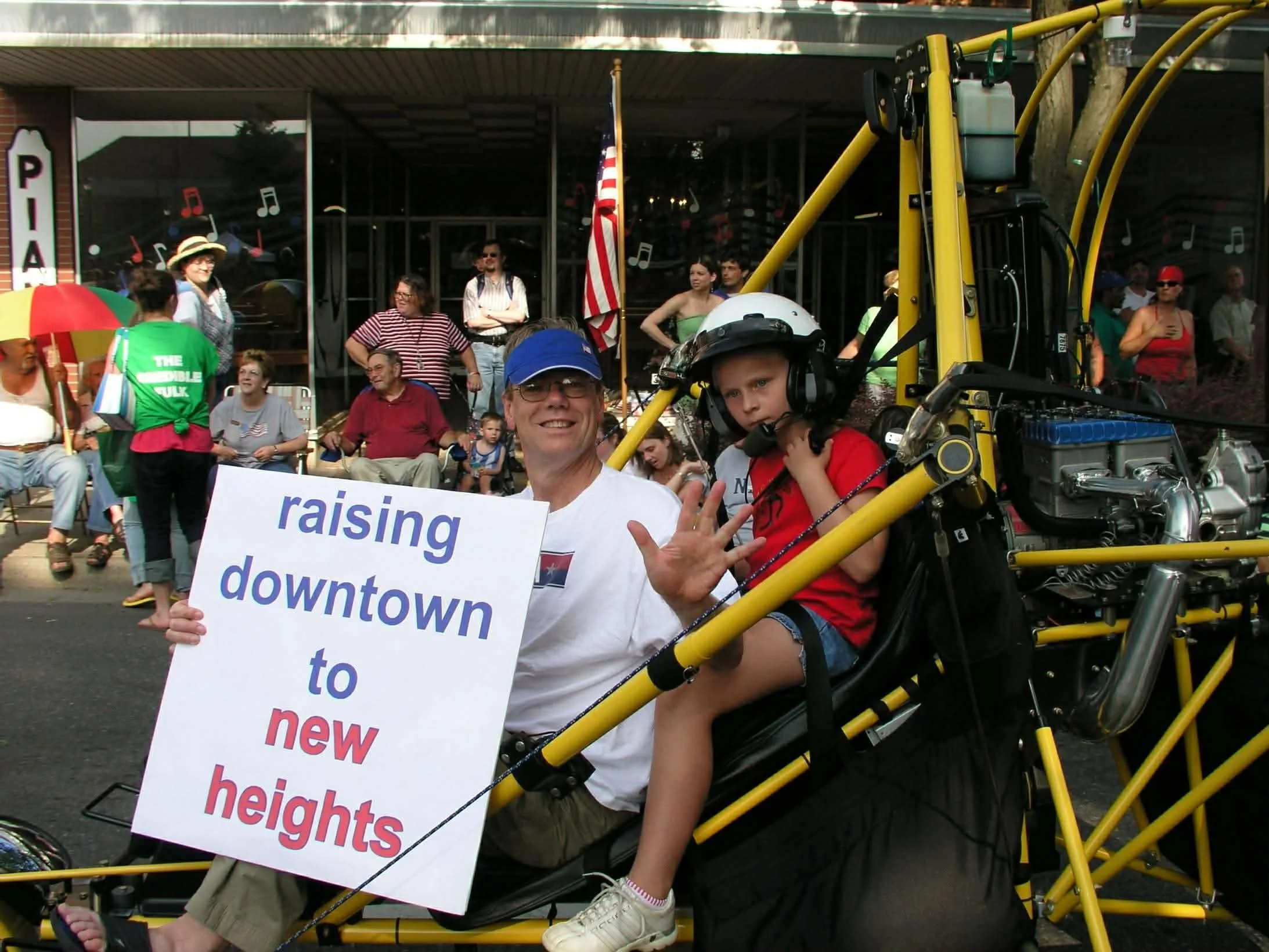
Steve Knickerehm with his son during a downtown parade. Date unknown.
My first memory of Steven Knickrehm was of him teasing HDR’s first executive director, Eddie Bumbaugh, for how he pronounced “wheelbarrow” while we were volunteering for Blacks Run Clean Up day about 10 years ago. Steve and I both picked up on Eddie’s creative pronunciation, which sounds more like “wheel burrough-a.”
Steve Knickrehm passed away on Sunday, January 25, 2026, after a battle with dementia. His leadership led to the founding of Harrisonburg Downtown Renaissance (HDR) in 2003, and he served as our first board president. As a downtown resident and as the current executive director of HDR, I feel grateful and indebted to him and his hard work.
It didn’t take anyone much time to realize that Steve had a great sense of humor and personality. Our lighthearted teasing of Eddie was in good fun, but it also didn’t take long for people to know when he was being serious. Both Eddie and current HDR board member and founder Andy Perrine agree that when Steve had something to say, everyone listened and quickly got on the same page.
“I’d describe him as a visionary but one who is based in reality,” said Eddie.
As the Associate Vice President of Finance and Administration for JMU, Steve had fond memories of the vibrant downtowns surrounding Virginia Tech and the University of Maryland, where he attended for undergraduate and graduate studies, and he wanted that for our city. His wife Kay, said he very much wanted that experience for JMU students, too.
Former Harrisonburg City Council member and mayor Larry Rogers had hired Eddie while he was at the Mediation Center to facilitate public engagement sessions in the early 2000s, as the community was grappling with what to do with a dying downtown.
At the time, Scott Bolsinger, a reporter and columnist for the regional newspaper, the Daily News Record, had published an opinion piece stating that downtown should close Main Street to auto traffic like Charlottesville and have a pedestrian mall. The community seemed divided on that idea, and Harrisonburg needed to chart a path forward.
“We identified community stakeholders to participate in these discussions, and [then-JMU President] Dr. Carrier selected Steve to represent JMU,” says Eddie. “We met at the downtown library to discuss what should be done with downtown. Steve emerged as a leader early on.”
In one of those meetings, community member and former HDR founding board member Diane Ehrenpris said that a pedestrian mall would not create an authentic experience. Steve agreed and suggested bringing in other communities to talk about their successes in reviving their downtowns.
Steve was aware of the revitalization already underway in Staunton, and after some digging, he learned that the city was following a methodology developed by the National Trust for Historic Preservation’s Main Street Center and was supported by the state’s Department of Housing and Community Development’s Virginia Main Street program.
This proven methodology, the Main Street Approach, gives organizations like HDR a framework to lead a public-private revitalization effort and to manage a long-term effort for community-based economic development for historic districts. HDR follows the Main Street model to this day and is still supported by Virginia Main Street and the National Main Street Center.
“Steve advocated for the Main Street model. And, when he spoke,” says Eddie, “people stopped arguing and listened. Pretty soon after that meeting, consensus was building that becoming a Main Street community made sense.”
“He wanted downtown to be a destination for locals as well as visitors. He wanted it to feel welcoming to the students,” says Kay. “He was very proud of how vibrant the community became.”
She went on to joke that his “only sense of failure was that we did not get a Trader Joe’s to open here.”
[As an economic development professional who is aware of Trader Joe’s site selection specifications, I wish I could have told him that this was no failure. The corporation has household density and median income requirements that our city hasn’t yet achieved, but that we could get there someday. Luckily, a strong downtown that anchors our community for resident retention and talent attraction could be part of our recipe for success to land Trader Joe’s…someday.]
JMU, under Dr. Carrier and then Dr. Rose’s leadership, became a strong proponent for a strong downtown. Steve and Andy eventually were introduced and began working together to get HDR off the ground. Andy had been a volunteer for the long-standing Citizens for Downtown organization that had worked for many years on various beautification and customer attraction strategies, and was a natural ally. They produced the Fridays on the Square concerts that were the inspiration for HDR’s Levitt AMP Harrisonburg music series. Andy had just been promoted to a new position at the university that was still being shaped. It was decided that in this new role, Andy would be tasked with bringing life to HDR.
“Steve asked me to help take the idea of forming HDR and joining the Main Street program to the city council. I created the PowerPoint presentation, Steve crafted the ask, and he recruited Eddie and [Glen Fair Price’s owner and founding HDR Board Member] Gary Stiteler to present to the city council with him,” says Andy. “I give him credit for taking this idea to the city council and asking for support to create a paid position so our organization could become more than a volunteer effort. That made all the difference for us.”
Some Main Street revitalization organizations only have a part-time director or remain a volunteer-driven effort, and too often that leads to inconsistent momentum or failed efforts. Today, Harrisonburg is an award-winning downtown for its revitalization milestones and successes. Our downtown and HDR are constantly held up as models to follow, not just in Virginia, but nationally. Since our inception, we have seen over $150 million in reinvestment downtown and over 500,000 volunteer hours to make the magic happen. Many people have been part of our almost 25-year success story, but as the spark that ignited the founding of HDR, this is truly one of Steve’s legacies.
Andy says one of the things that impressed him the most is that Steve was an incredible businessman and he brought those skills to the boardroom.
“He brought good governance to the organization, making sure that board members knew their roles and set expectations. He was an expert in Robert’s Rules of Order to run our meetings, and it made us feel like we were part of a serious organization that was substantive. He made us feel like we were a part of something big.”
If you enjoyed the holiday parade with the JMU Marching Royal Dukes (MRDs) in December, you should know that Steve was behind this beloved holiday tradition. After HDR got up and running in July 2003, Eddie said he was curious if they could celebrate with the MRDs by inviting them to march in the holiday parade.
“Steve set up a meeting with Eddie and Pat Rooney, who was the band director then, to ask if they would agree to the parade just this one time,” says Eddie. “Pat said he would only do it if it became an annual occurrence and that the band could also play a concert from the courthouse steps. It exceeded our expectations. Steve was always a calm person, but he was just giddy over this idea. It is something that delights our community to this day.”
Even after stepping away from the Board of Directors and retiring, he still kept in touch with HDR. He often joined current and past board members for happy hour, and Kay said he really enjoyed meeting up at Dave’s Taverna. He would volunteer with us, just like the first time we did during Blacks Run Clean Up Day.
Please, cheers to Steve the next time you meet friends for happy hour downtown and think of him during the next MRDs concert after the holiday parade. Take a walk around downtown and think about how far we have come and how people like him made it happen because of their passion and vision. Think about what kind of mark you can make on our community and keep his spirit alive.
Thank you, Steve. You did it.
We promise to keep it going.